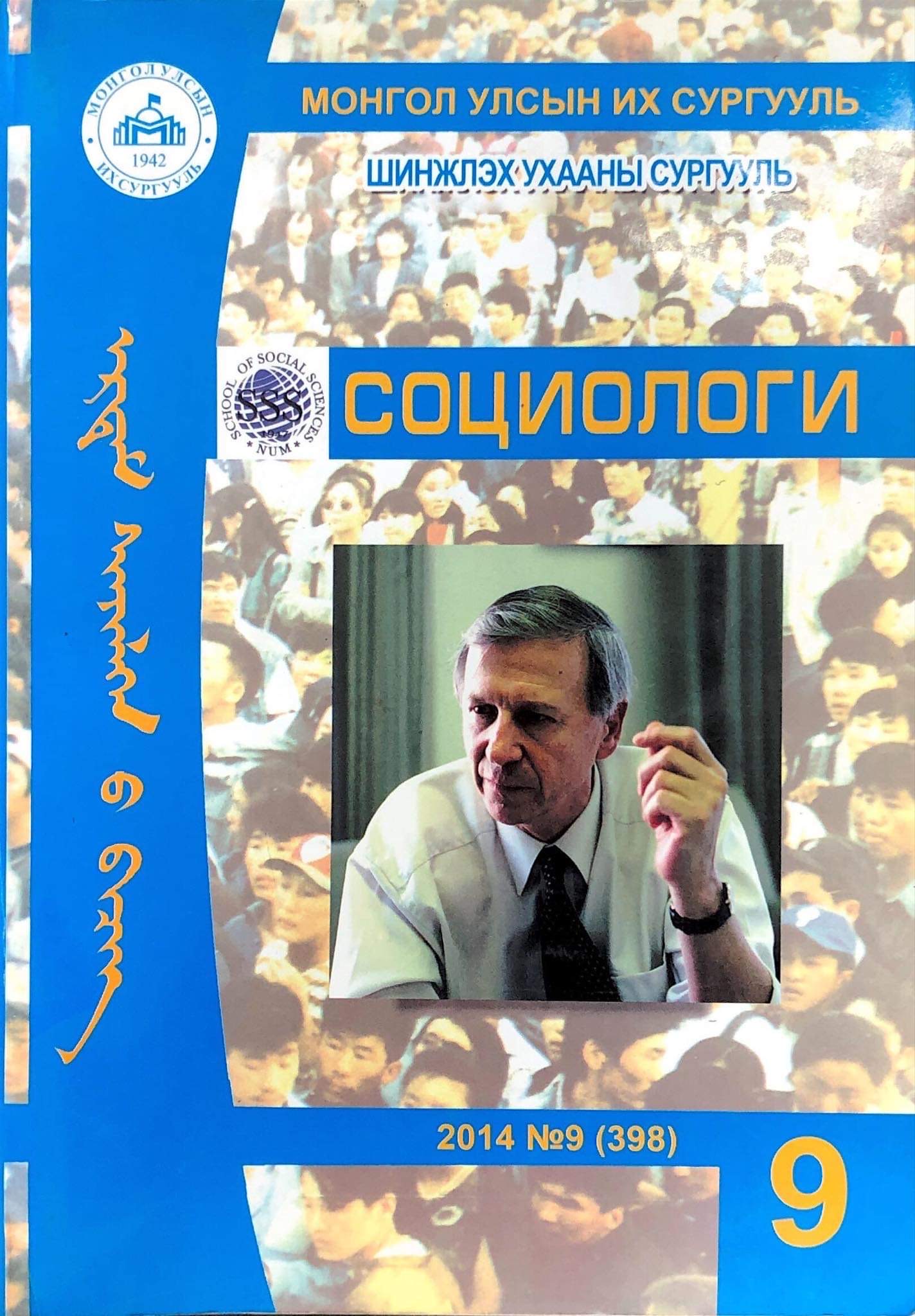
Э.ГИДДЕНС: ОРЧИН ҮЕИЙН НИЙГМИЙН ТӨЛӨВ: ОНОЛЫН МАКРО БА МИКРО ТҮВШНИЙ ИНТЕГРАЦЧИЛАЛ
Keywords:
Key words; Anthony Giddins, Ulrich Beck, Theory of Structuration, social system, social interaction micro and macro issues, Moderniry and Self-Identity, Rationality, Social change, Reflexive Modernity Utopian Realism, The Transformation of Intimacy, Risky SocietyAbstract
Abstract: Structuration is very useful in synthesizing micro and macro issues. On a micro scale, one of individuals’ internal sense of self and identity, consider the example of a family: we are increasingly free to choose our own mates and how to relate with them, which creates new opportunities but also more work, as the relationship becomes a reflexive project that has to be interpreted and maintained. Yet this micro-level change cannot be explained only by looking at the individual level as people did not spontaneously change their minds about how to live; neither can we assume they were directed to do so by social institutions and the state.
Giddens’ recent work has been concerned with the question of what is characteristic about social institutions in various points of history. Giddens agrees that there are very specific changes that mark our current era, but argues that it is not a “post-modern era”, but just a “radicalised modernity era” (similar to Zygmunt Bauman’s concept of liquid modernity), produced by the extension of the same social forces that shaped the previous age. Giddens nonetheless differentiates between pre-modern modern and late (high) modern societies and doesn’t dispute that important changes have occurred but takes a neutral stance towards those changes, saying that it offers both unprecedented opportunities and unparalleled dangers. He also stresses that we haven’t really gone beyond modernity. It’s just a developed, detraditionalized, radicalised, ‘late’ modernity. Thus the phenomena that some have called ‘postmodern’ are to Giddens nothing more than the most extreme instances of a developed modernity. Giddens concentrates on a contrast between traditional (pre-modern) culture and post- traditional (modern) culture. In traditional societies, individual actions need not to be extensively thought about because available choices are already predetermined (by the customs, traditions etc.). In contrast,in post-traditional society people (actors, agents) are much less concerned with the precedents set by earlier generations, and they have more choices, due to flexibility of law and public opinion. This however means that individual actions now require more analysis and thought before they are taken. Society is more reflexive and aware, something Giddens is fascinated with, illustrating it with examples ranging from state governance to intimate relationships.