
Environmental Rights in Mongolia and Beyond - A Comparative Analysis
DOI:
https://doi.org/10.22353/nlr.2025.06.20Keywords:
Environmental Rights, Cultural Context, Environmental Duty, ImplementationAbstract
This article investigates the global trend of incorporating environmental rights into constitutions, with a specific focus on Mongolia’s constitutional framework. It analyses the revolution of environmental rights on a global scale while highlighting Mongolia’s unique approach to integrating substantive and procedural environmental rights, as well as an individual environmental duty, into the 1992 constitution. The authors argue that while constitutional environmental rights offer a powerful framework and legal mechanism for environmental protection, their effectiveness depends on consistent application and enforcement and on genuinely reflecting the context in which the rights are addressed. Thus, the article concludes by suggesting in-depth, context-sensitive studies to understand the practical impact of environmental rights in Mongolia and elsewhere, ultimately aiming to enhance the lives of those most vulnerable to environmental degradation.
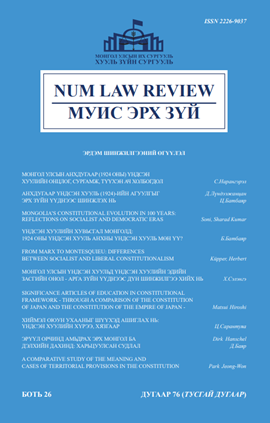
Эрүүл орчинд амьдрах эрх Монгол ба дэлхийн дахинд: Харьцуулсан судлал
Downloads
Published
How to Cite
Issue
Section
License
Copyright (c) 2025 Dirk Hanschel, Bayar Dashpure

This work is licensed under a Creative Commons Attribution-NonCommercial 4.0 International License.
Copyright on any research article in the NUM Law Review is retained by the author(s).
The authors grant the NUM Law Review license to publish the article and identify itself as the original publisher.

Articles in the NUM Law Review are Open Access articles published under a Creative Commons Attribution-NonCommercial 4.0 International License - CC BY NC.
This license permits use, distribution and reproduction in any medium, provided the original work is properly cited.
