
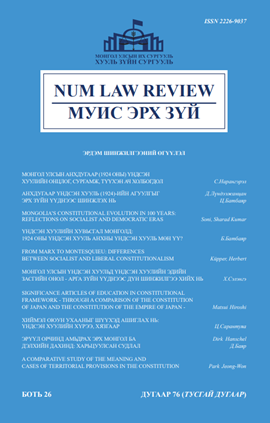
A Comparative Study of the Meaning and Cases of Territorial Provisions in the Constitution
DOI:
https://doi.org/10.22353/nlr.2025.06.22Keywords:
Constitution, Territorial Provision, Unification, Divides Countries, Inter-Korean Relationm, German unificationAbstract
In comparison, territorial regulations, which are a component of the state, vary depending on the circumstances of each country. Dealing with the territory is different depending on the reasons that have characteristics of each country. Each country’s constitution has different backgrounds and contents of territorial provisions, but it can be categorized and reviewed according to the contents of the regulations. In particular, in the case of a divided country, the division of the territory is premised, and the integration of the people along with the integration of the territory is a prerequisite for unification. Overcoming division requires a solution to the fateful task of integrating separate territories. In the case of the Korean Peninsula, in light of the situation in which South Korea and North Korea are divided, the unification of the two Koreas is set as a fatalistic goal as the same nation. In the process of overcoming division and completing unification, territorial integration, which is governed separately, involves the legal nature of inter-Korean relations and the legal status of the two Koreas to each other. In our case, inter-Korean relations are called special relations in that they are viewed as domestic legal relations within the nation, not international legal relations between countries. North Korea tries to establish inter-Korean relations as an interstate relationship, but South Korea still has not approved North Korea as an international legal state. Still, based on the specificity of inter-Korean relations, North Korea maintains that it has a dual character of being an anti-state organization and a counterpart in exchange and cooperation. In the case of a divided country, as it presupposes the will and agreement of the other party, opinions on the value and effect of each stipulated territorial provision work strongly. In order to overcome the division, it is important to make a judgment in consideration of the historical, normative, and unification principles that the territorial provisions traditionally contain. It is significant that the territorial provisions of Korea, a divided country, are compared with those of other divided and disputed countries. Constitutional territorial provisions have been revised along with unification with their own meaning according to the background. In the process of German unification, the territorial provisions of the Old West German Basic Law have great implications in that they eventually functioned as the constitutional basis for German unification This study examines the importance and value of constitutional norms for the territory, which is one of the constituent elements of the state under the constitution, and classifies the types of territorial provisions of major countries to examine each characteristic. Through this discussion, we examine the meaning and type of territorial provisions in each constitution, and re-examine the meaning and value of territorial provisions under the constitution in the situation of division in Korea.
Үндсэн хууль дахь нутаг дэвсгэрийн заалтуудын агуулга ба практик хэрэглээний харьцуулалт
Downloads
Published
How to Cite
Issue
Section
License
Copyright (c) 2025 Park Jeong-Won

This work is licensed under a Creative Commons Attribution-NonCommercial 4.0 International License.
Copyright on any research article in the NUM Law Review is retained by the author(s).
The authors grant the NUM Law Review license to publish the article and identify itself as the original publisher.

Articles in the NUM Law Review are Open Access articles published under a Creative Commons Attribution-NonCommercial 4.0 International License - CC BY NC.
This license permits use, distribution and reproduction in any medium, provided the original work is properly cited.
