
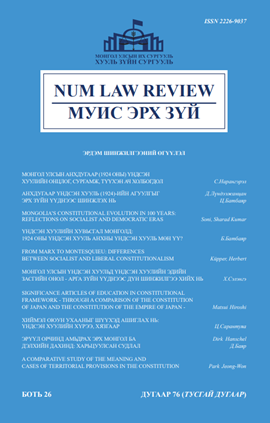
From Marx to Montesquieu: Differences between Socialist and Liberal Constitutionalism
DOI:
https://doi.org/10.22353/nlr.2025.06.09Keywords:
Constitutionalism, Socialist State Theory, Pluralist Democracy, Separation of Powers, Checks and Balances, Rule of Law, Market Economy, Human Rights and FreedomsAbstract
Socialist constitutions very much looked like their Western counterparts: a written document on the top of the legal hierarchy with state principles, rules on state organisation and basic rights. Despite the similar appearance, in content they were fundamentally different from liberal documents. The most important difference was the compulsory ideology and its guardian, the Communist Party (CP). Elections did not function to award a political choice but to legitimise the rule of the CP. The ideology required the subordination of the state and its law, including the constitution, under the tutelage of the CP. Formally relying on Rousseau, socialist constitutionalism rejected all checks and balances, advocating a ‘socialist division of labour’ among state organs. The hyper-centralised ‘monolithic’ state did not accept any separation of powers, neither horizontal nor vertical. Basic rights were interpreted as granted by the state and could be exercised only in a way the CP accepted.
When socialism ended, most states wanted to establish a liberal democracy, true human rights and freedoms, a market economy, and a rule of law. This required a shift from socialist to liberal constitutionalism. The most important change was the abolition of the compulsory ideology and the acceptance of political pluralism. This entailed a new quality of individual political rights and freedoms such as the liberty to form or join parties. The socialist state had to be decentralised by, inter alia, the introduction of a separation of powers and checks and balances, and by restoring local and other autonomy. Replacing a planned by a market economy required a new quality of individual economic and social rights as well as a re-definition of the economic role of the state. Finally, constitutional rights had to be re-defined as a true empowerment of the individual. These changes were essential for the creation of the rule of law.
Downloads
Published
How to Cite
Issue
Section
License
Copyright (c) 2025 Küpper Herbert

This work is licensed under a Creative Commons Attribution-NonCommercial 4.0 International License.
Copyright on any research article in the NUM Law Review is retained by the author(s).
The authors grant the NUM Law Review license to publish the article and identify itself as the original publisher.

Articles in the NUM Law Review are Open Access articles published under a Creative Commons Attribution-NonCommercial 4.0 International License - CC BY NC.
This license permits use, distribution and reproduction in any medium, provided the original work is properly cited.
