
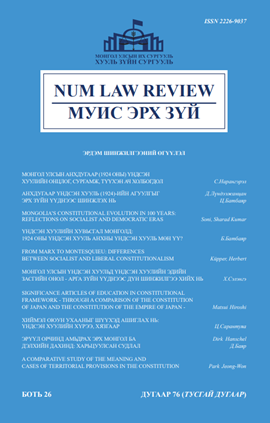
Mongolia’s Constitutional Evolution in 100 Years: Reflections on Socialist and Democratic Eras
DOI:
https://doi.org/10.22353/nlr.2025.06.07Keywords:
Post-Independence Mongolia, Constitutional Evolution, Socialist Era, Democratic Era, One-Party Rule, Multi-Party SystemAbstract
A century has passed since Mongolia embarked on its constitutional evolution in 1924 when the first constitution was adopted. The 1924 constitution, for the first time, set the tone for the constitutional form of governance by laying down the legal frame-work of the political regime of what came to be known as the Mongolian People’s Republic. This marked the beginning of the socialist era in the history of postindependence Mongolia with Mongolian People’s Revolutionary Party ruling the government under the system of a one-party rule. The second and third constitutions were adopted in 1940 and 1960 respectively. While the 1940 constitution emphasized on non-capitalist lines with subsequent development into socialism, the 1960 constitution proclaimed the attainment of socialism until it was amended in 1990 to approve a pluralistic democracy with a multi-party system. Consequently, a new constitution, the fourth one since 1924, was adopted in 1992. By employing an electoral democracy and dissolving the Mongolian People’s Republic, this constitution marked an unambiguous departure from the socialist era, particularly in terms of Soviet influence and entered into a democratic era. It is in this background that the main objective of the present work is to reflect upon Mongolia’s constitutional evolution during socialist and democratic eras in a comparative perspective. It critically reviews the notions behind constitutional amendments and their implications for the political landscape of Mongolia in a long span of 100 years. It argues that although the constitutions of the two eras remain quite different in terms of convergence, they do provide a clear picture of what the country’s political system was during its Soviet past and its appearance in the present in terms of socialist versus democratic credentials.
Downloads
Published
How to Cite
Issue
Section
License
Copyright (c) 2025 Soni Sharad Kumar

This work is licensed under a Creative Commons Attribution-NonCommercial 4.0 International License.
Copyright on any research article in the NUM Law Review is retained by the author(s).
The authors grant the NUM Law Review license to publish the article and identify itself as the original publisher.

Articles in the NUM Law Review are Open Access articles published under a Creative Commons Attribution-NonCommercial 4.0 International License - CC BY NC.
This license permits use, distribution and reproduction in any medium, provided the original work is properly cited.
