
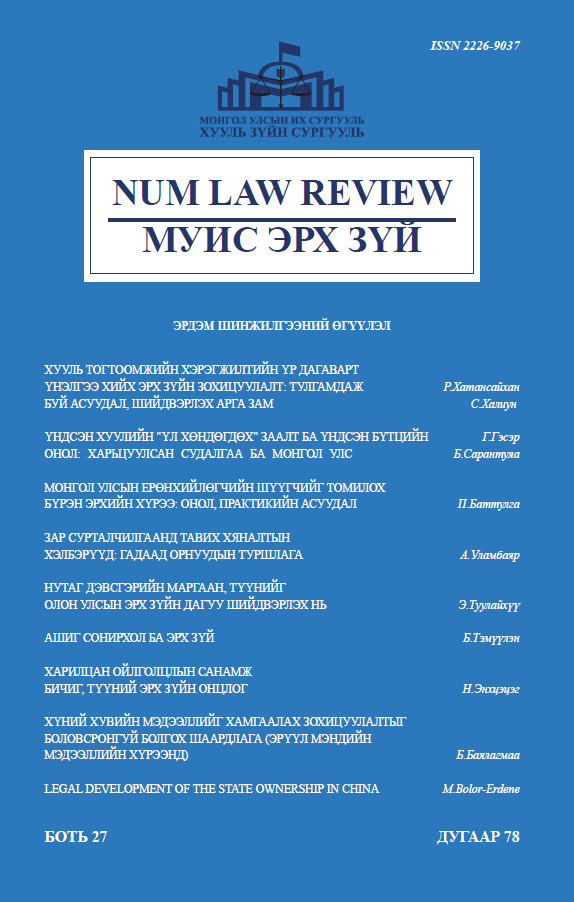
Legal Development of the State Ownership in China
DOI:
https://doi.org/10.22353/nlr.2026.02.16Keywords:
State owned enterprise, State ownership and Socialist market economyAbstract
Since the adoption of China’s reform and opening-up policy at the Third Plenary Session of the 11th CPC Central Committee in 1978, the Chinese economy has gradually shifted from a centrally planned system to a socialist market economy. Within this transformation, the reform of state-owned enterprises (SOEs) has served as a core pillar of economic modernization and legal restructuring. This paper examines the legal development of state ownership in China through a historical and institutional lens, focusing on the progressive separation of government and enterprise functions (政企分开), corporatization reforms, and the establishment of a state asset governance framework. The paper traces early administrative reforms in the 1980s—such as profit retention, contract responsibility, and the factory director responsibility system—which reduced direct bureaucratic control over enterprise operations. It then highlights the emergence of a formal legal foundation for SOEs, particularly through the 1988 Industrial Enterprises Law, followed by the decisive shift to corporatization after the 1993 CCP Decision on establishing a socialist market economy. The Company Law (1993) and Securities Law (1998) enabled the creation of modern enterprise structures and capital markets, facilitating SOE restructuring into limited liability companies and joint stock companies. The late-1990s consolidation period, accompanied by bankruptcy mechanisms and restructuring policies, further advanced market-based discipline. The establishment of the State-owned Assets Supervision and Administration Commission (SASAC) in 2003 and the adoption of the Enterprise State-owned Assets Law (2008) marked the institutionalization of state ownership management through investor-style governance. In the Xi Jinping era, reforms increasingly emphasize mixed ownership, performance accountability, compliance systems, and strategic sector leadership, while reinforcing Party leadership in corporate governance through mechanisms such as 双向进入, 交叉任职. The paper concludes that China’s legal development of state ownership reflects a dual trajectory: market-oriented corporate reform combined with enduring state control and Party governance, shaping a distinctive model of state capitalism under law.
Downloads
Published
How to Cite
Issue
Section
License
Copyright (c) 2026 Bolor-Erdene Munkhsaikhan

This work is licensed under a Creative Commons Attribution-NonCommercial 4.0 International License.
Copyright on any research article in the NUM Law Review is retained by the author(s).
The authors grant the NUM Law Review license to publish the article and identify itself as the original publisher.

Articles in the NUM Law Review are Open Access articles published under a Creative Commons Attribution-NonCommercial 4.0 International License - CC BY NC.
This license permits use, distribution and reproduction in any medium, provided the original work is properly cited.
