
The Scope of the President of Mongol’s Power to Appoint Judges: Theoretical and Practical Issues
DOI:
https://doi.org/10.22353/nlr.2026.02.03Keywords:
President, Judicial Appointments, Judicial Independence, Judicial General Council, Constitution, Administrative Act, Judicial ReviewAbstract
This article examines the nature and scope of the President of Mongolia’s power to appoint judges, its constitutional rationale, legal limits, and issues arising in its practical implementation. Under the Constitution of Mongolia, the President is vested with the authority to appoint judges. This power is intended both to ensure the democratic legitimacy of the judicial branch and to safeguard judicial independence; however, the exercise of this authority has continued to give rise to controversy in practice.
The study analyzes the legal framework governing the judiciary in force between 1993 and 2025, the practice of presidential refusals to appoint judicial nominees, and relevant decisions of the Constitutional Court and the administrative courts. It also considers comparable disputes that have arisen in Poland and reviews recommendations issued by international organizations. The study concludes that the President’s authority to appoint judges should not be regarded as a discretionary power but rather as a limited and confirmatory authority. Furthermore, it finds that greater openness and transparency, as well as improvements to the legal framework governing the exercise of this power, are necessary.
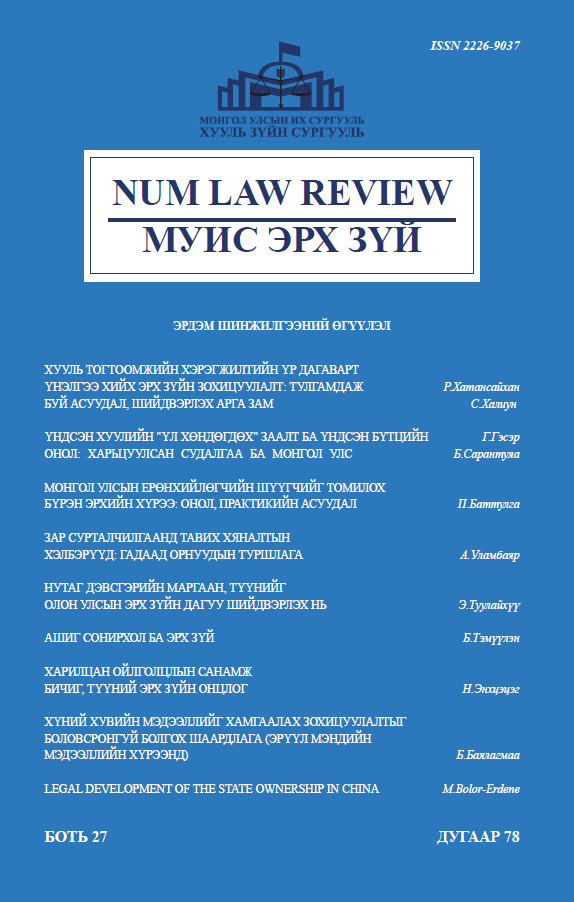
Монгол Улсын Ерөнхийлөгчийн шүүгчийг томилох
бүрэн эрхийн хүрээ: Онол, практикийн асуудал
[Товч утга]
Энэхүү өгүүлэлд Монгол Улсын Ерөнхийлөгчийн шүүгчийг томилох бүрэн эрхийн агуулга, түүний Үндсэн хуулийн үзэл санаа, эрх зүйн хязгаар, бодит хэрэгжилтийн асуудлыг онол, эрх зүйн зохицуулалт болон шүүхийн практикт тулгуурлан шинжилсэн болно. Монгол Улсын Үндсэн хуулиар Ерөнхийлөгчид шүүгчийг томилох бүрэн эрх олгосон нь шүүх эрх мэдлийн ардчилсан легитим байдлыг хангахын зэрэгцээ шүүхийн хараат бус байдлыг баталгаажуулах зорилготой боловч уг бүрэн эрхийн хэрэгжилт нь бодит байдал дээр маргаан дагуулсаар байдаг. Судалгаанд 1993–2025 оны хооронд хүчин төгөлдөр үйлчилж байсан шүүхийн тухай хууль тогтоомжийн зохицуулалт, Ерөнхийлөгчийн шүүгч томилохоос татгалзсан практик, Үндсэн хуулийн цэц болон захиргааны хэргийн шүүхийн шийдвэрүүдэд дүн шинжилгээ хийсэн. Мөн Польш Улсад үүссэн ижил төстэй маргаан, олон улсын байгууллагуудын зөвлөмжийг харьцуулан авч үзсэн болно. Судалгааны үр дүнд Ерөнхийлөгчийн шүүгч томилох бүрэн эрх нь үзэмжийн шинжтэй бус, харин хязгаарлагдмал, баталгаажуулах шинжтэй байх ёстой бөгөөд уг бүрэн эрхийн хэрэгжилтэд нээлттэй, ил тод байдлыг хангах, холбогдох эрх зүйн зохицуулалтыг илүү сайжруулах шаардлагатай гэж дүгнэв.
[Түлхүүр үг]
Ерөнхийлөгч, шүүгчийн томилгоо, шүүхийн хараат бус байдал, Шүүхийн ерөнхий зөвлөл, Үндсэн хууль, захиргааны акт, шүүхийн хяналт.
Downloads
Published
How to Cite
Issue
Section
License
Copyright (c) 2026 Battulga Purvee

This work is licensed under a Creative Commons Attribution-NonCommercial 4.0 International License.
Copyright on any research article in the NUM Law Review is retained by the author(s).
The authors grant the NUM Law Review license to publish the article and identify itself as the original publisher.

Articles in the NUM Law Review are Open Access articles published under a Creative Commons Attribution-NonCommercial 4.0 International License - CC BY NC.
This license permits use, distribution and reproduction in any medium, provided the original work is properly cited.
