
The Limits of Amendment: A Comparative Analysis of Eternity Clauses, the Basic Structure Doctrine, and the Case of Mongolia
DOI:
https://doi.org/10.22353/nlr.2026.02.02Keywords:
Сonstitution, unamendable provisions, eternity clause, basic structure doctrine, constitutional amendment, constitutional supremacyAbstract
This study examines the theoretical and legal content of the concept of the “basic structure” of a constitution, and explores whether this concept is predetermined in substance a priori or may be interpreted and determined by a constitutional court on a case-by-case, ad hoc basis. It also analyzes whether the provisions of the Law on the Procedure for Amending the Constitution of Mongolia, which prohibit amendments to certain provisions of the Constitution, reflect the fundamental principles of democracy and the substantive content of the Constitution’s basic structure. Furthermore, within the framework of comparative research, the study will examine constitutions of various countries through the Comparative Constitutions Project, which was developed to identify and compare the origins, development, and substantive content of constitutions around the world. In doing so, the study will compare how different states incorporate and regulate unamendable fundamental principles, or “eternity clauses” in their constitutions. The study seeks to answer the following three main research questions:
- Whether the basic structure of a constitution is an a priori concept, predetermined in its substantive content, or whether it is a concept that should be determined by a constitutional court on ad hoc basis;
- Whether Article 5.2.2 of the Law on the Procedure for Amending the Constitution of Mongolia which provides that “ Articles One, Two, Three, and Four, Paragraphs 1-3 of Article Five, Paragraph 1 of Article Six, Paragraph 1 of Article Eight, Paragraph 2 of Article Nine, Paragraphs 1 and 2 of Article Ten, Paragraph 1 of Article Twelve, Articles Fourteen, Fifteen, Nineteen, Paragraph 1 of Article Twenty-two, Paragraph 1 of Article Thirty-eight, Paragraph 2 of Article Forty-one, Article Forty-seven, Paragraphs 1 and 2 of Article Forty-nine, Sixty-eight, and Sixty-nine of the Constitution shall not be amended;” affects the fundamental principles of democratic constitutionalism;
- Within the above framework, the relevant practices of other countries, commonly applied international approaches, and the theoretical foundations concerning this issue.
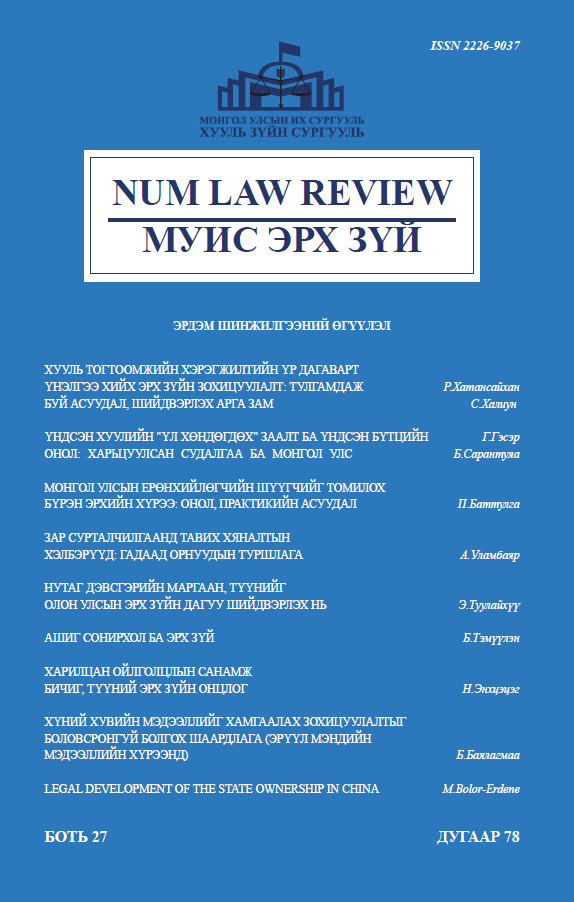
Үндсэн хуулийн "үл хөндөгдөх" заалт ба үндсэн
бүтцийн онол: Харьцуулсан судалгаа ба Монгол Улс
[Товч утга]
Энэхүү судалгааны ажлын хүрээнд Үндсэн хуулийн “үндсэн бүтэц” (basic structure) хэмээх ойлголтын онол, эрх зүйн агуулгыг тодорхойлох, уг ойлголт нь агуулгын хувьд урьдчилан тогтоогдсон (a priori) шинжтэй эсхүл Үндсэн хуулийн шүүхээс тухай бүрд (ad hoc) тайлбарлан тогтоогдох боломжтой эсэх асуудлыг судална. Мөн Монгол Улсын Үндсэн хуульд нэмэлт, өөрчлөлт оруулах журмын тухай хуулийн холбогдох заалтад тусгагдсан Үндсэн хуулийн зарим зүйл заалтад өөрчлөлт оруулахыг хориглосон зохицуулалтууд нь ардчиллын суурь зарчим, Үндсэн хуулийн үндсэн бүтцийн агуулгыг илэрхийлж байгаа эсэхийг шинжилнэ. Түүнчлэн харьцуулсан судалгааны хүрээнд дэлхийн улс орнуудын Үндсэн хуулийн гарал үүсэл, хөгжил, агуулгыг тодорхойлох үүднээс боловсруулсан Харьцуулсан Үндсэн хуулийн төсөл (Comparative Constitutions Project)-өөс улс орнуудын Үндсэн хуулийг судалж Үндсэн хуульдаа үл хөндөгдөх тулгуур зарчим (үүрдийн баталгаа)-ыг тусгаж зохицуулсан байдлыг харьцуулна. Судалгаа нь дараах гурван үндсэн хэсэг бүхий асуултуудад хариулах болно. Үүнд: 1. Үндсэн хуулийн үндсэн бүтэц гэдэг нь “a priori’ буюу агуулгын хувьд урьдчилан тогтоосон, эсхүл үндсэн хуулийн шүүх “ad hoc” буюу тухай бүрд тогтоох ёстой ойлголт эсэх; 2. Монгол Улсын Үндсэн хуульд нэмэлт, өөрчлөлт оруулах журмын тухай хуулийн 5 дугаар зүйлийн 5.2.2 дахь заалтад “Үндсэн хуулийн Нэг, Хоёр, Гурав, Дөрөвдүгээр зүйл, Тавдугаар зүйлийн 1 дэх хэсэг, Есдүгээр зүйлийн 2 дахь хэсэг, Аравдугаар зүйлийн 1, 2 дахь хэсэг, Арван хоёрдугаар зүйлийн 1 дэх хэсэг, Арвам дөрөв, Арван тав, Арван ес, Хорин хоёрдугаар зүйлийн 1 дэх хэсэг, Гучин наймдугаар зүйлийн 1 дэх хэсэг, Дөчин нэгдүгээр зүйлийн 2 дахь хэсэг, Дөчин долдугаар зүйл, Дөчин есдүгээр зүйлийн 1, 2 дахь хэсэг, Жаран найм, Жаран есдүгээр зүйлд нэмэлт, өөрчлөлт оруулж үл болно;” гэж зааснаар ардчилсан үндсэн хуульт ёс (constitutionalism)- ны суурь зарчмыг хөндсөн эсэх; 3. Дээрх агуулгын хүрээнд бусад улсын жишиг, олон улсад нийтлэг хэрэглэгддэг зарим туршлага, энэ талаарх онолын үндэслэл.
[Түлхүүр үг]
Үндсэн хууль, үл хөндөх заалт, үүрдийн баталгаа, үндсэн бүтцийн номлол, Үндсэн хуулийн нэмэлт, өөрчлөлт, Үндсэн хуулийг дээдлэх зарчим.
Downloads
Published
How to Cite
Issue
Section
License
Copyright (c) 2026 Geser Ganbaatar, Sarantuya Baatar

This work is licensed under a Creative Commons Attribution-NonCommercial 4.0 International License.
Copyright on any research article in the NUM Law Review is retained by the author(s).
The authors grant the NUM Law Review license to publish the article and identify itself as the original publisher.

Articles in the NUM Law Review are Open Access articles published under a Creative Commons Attribution-NonCommercial 4.0 International License - CC BY NC.
This license permits use, distribution and reproduction in any medium, provided the original work is properly cited.
