
Legal Regulation for Conducting Ex-Post Evaluation of the Implementation Outcomes of Legislation: Challenges and Solutions
DOI:
https://doi.org/10.22353/nlr.2026.02.01Keywords:
Legislation, Ex-post Legislative Impact Assessment, Implementation Challenges, National Legal Institute, Human Resources, Professional Capacity, TrainingAbstract
Until 2015, the process of initiating, drafting, and submitting legislation to the State Great Khural was carried out intensively. During this period, the laws adopted and enforced by the State Great Khural tended to be developed primarily in response to the socio-economic needs of the time rather than being based on systematic planning and thorough research. This issue was specifically noted in the concept paper of the revised draft Law on Procedures for Drafting, Submitting, and Implementing Legislation. Furthermore, the Government Action Plan of Mongolia for 2012–2016, approved by Resolution No. 37 of the State Great Khural in 2012, included a provision to “adopt the Law on Legislation and assess the necessity and implementation of laws.” Consequently, beginning with the Law on Legislation (2015), Mongolia established a legal framework for evaluating the implementation of legislation. This article examines the legal framework for conducting legislative impact assessments and the challenges associated with it. In doing so, it identifies the difficulties encountered in implementing the mandate of the National Legal Institute to regularly evaluate the implementation of legislation governing general relations in the fields of criminal, civil, administrative, and petty offense law, and proposes specific recommendations aimed at addressing these issues.
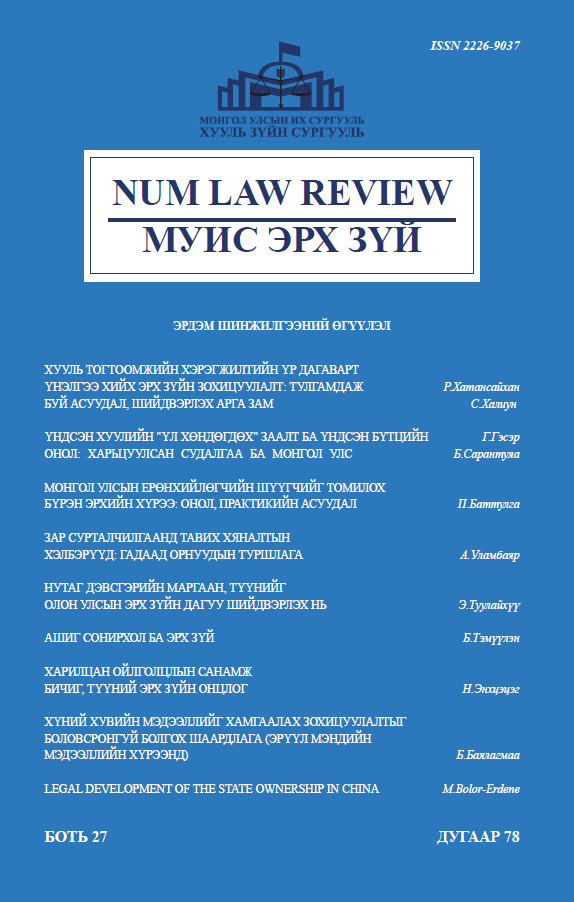
Хууль тогтоомжийн хэрэгжилтийн үр дагаварт үнэлгээ хийх эрх зүйн зохицуулалт: тулгамдаж буй асуудал, шийдвэрлэх арга зам
[Товч утга]
2015 оныг хүртэлх хугацаанд Улсын Их Хурлаас баталсан хууль тогтоомж нь тодорхой төлөвлөгөө, тооцоо судалгаанд үндэслэхээс илүүтэйгээр тухайн цаг үеийнхээ нийгэм, эдийн засгийн шаардлагад нийцүүлэн боловсруулах хандлагатай байв. Үүнийг өөрчлөх үүднээс Улсын Их Хурлын 2012 оны 37 дугаар тогтоолоор батлагдсан Монгол Улсын Засгийн газрын 2012-2016 оны үйл ажиллагааны мөрийн хөтөлбөрт “Хуулийн тухай хуулийг батлуулж, хуулийн хэрэгцээ шаардлага, хэрэгжилтийг үнэлэх”-ээр заасан.
Уг хэрэгцээ, шаардлагад үндэслэж, Хууль тогтоомжийн төсөл боловсруулах, өргөн мэдүүлэх, хууль тогтоомжийг хэрэгжүүлэх журмын тухай хуулийн төслийн шинэчилсэн найруулгыг боловсруулж, хуулийн хэрэгцээ, шаардлагыг тандан судлах, зардлыг тооцох, төсөл болон хэрэгжилтийн үр дагаврыг үнэлэх эрх зүйн орчныг бүрдүүлсэн.
Энэхүү өгүүлэлд хууль тогтоомжийн хэрэгжилтийн үр дагаварт үнэлгээ хийх эрх зүйн орчин болон эрүү, иргэн, захиргаа, зөрчлийн эрх зүйн салбарын нийтлэг харилцааг зохицуулж буй хууль тогтоомжийн хэрэгжилтийг тогтмол үнэлэхэд тулгарч буй хүндрэл, бэрхшээлийг судалж, түүнийг даван туулахад чиглэсэн тодорхой саналыг дэвшүүлэв.
[Түлхүүр үг]
Хууль тогтоомж, хэрэгжилтийн үр дагаварт үнэлгээ хийх, тулгамдаж буй асуудал, хууль зүйн үндэсний хүрээлэн, хүний нөөц, боловсон хүчин.
Downloads
Published
How to Cite
Issue
Section
License
Copyright (c) 2026 Khatansaikhan Ravdandorj, Khaliun Sarantuya

This work is licensed under a Creative Commons Attribution-NonCommercial 4.0 International License.
Copyright on any research article in the NUM Law Review is retained by the author(s).
The authors grant the NUM Law Review license to publish the article and identify itself as the original publisher.

Articles in the NUM Law Review are Open Access articles published under a Creative Commons Attribution-NonCommercial 4.0 International License - CC BY NC.
This license permits use, distribution and reproduction in any medium, provided the original work is properly cited.
