
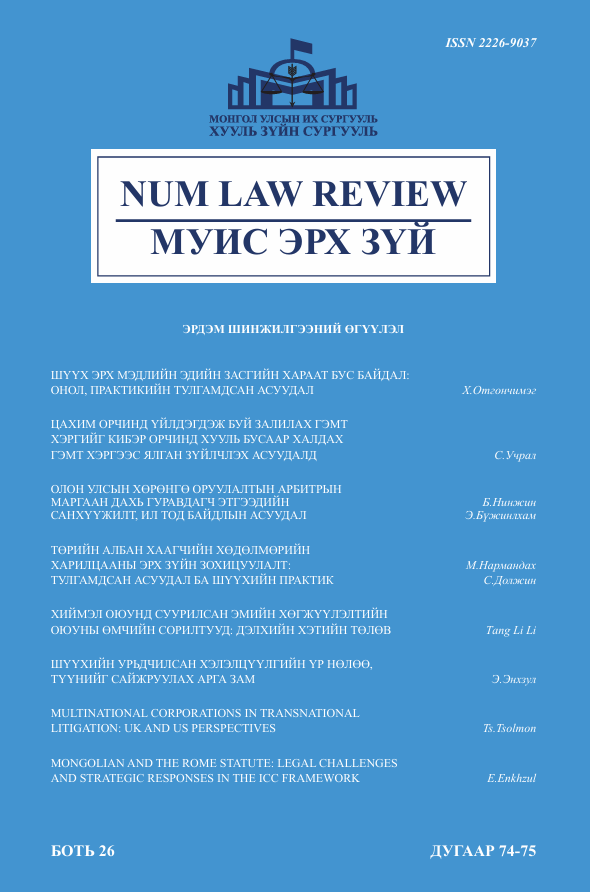
Mongolia and the Rome Statute: Legal Challenges and Strategic Responses in the ICC Framework
DOI:
https://doi.org/10.22353/nlr.2025.04.08Keywords:
International Criminal Court, Rome Statute, State cooperation, Head-of- state immunity, complementarity, sovereignty, diplomacy, compliance, mechanism, geopolitics, legal framework, accountabilityAbstract
This paper analyzes the legal and geopolitical implications of Vladimir Vladimirovich Putin’s 2024 visit to Mongolia, which triggered one of the first cases where a State Party to the Rome Statute of the International Criminal Court was found non-compliant under Article 87(7) for failing to arrest a sitting head of state subject to an ICC warrant. The study examines the intersection of international law and geopolitical realities, highlighting how major powers’ non-membership in the International Criminal Court (ICC) creates uneven standards for compliance. It argues that Mongolia’s inability to appeal the ICC decision reflects not only diplomatic constraints but also gaps in domestic legal and institutional mechanisms—particularly under Article 97, which allows states to formally notify the Court of cooperation difficulties. Drawing on comparative analysis of the Omar al-Bashir case and Germany’s implementation model, the paper identifies legal reforms needed to embed complementarity principles and establish clear institutional frameworks. It concludes that strengthening national legal systems is essential for smaller states to navigate between legal obligations and geopolitical pressures, ensuring both compliance and sovereignty protection.
Downloads
Published
How to Cite
Issue
Section
License
Copyright (c) 2025 Enkhzul Erdenebaatar

This work is licensed under a Creative Commons Attribution-NonCommercial 4.0 International License.
Copyright on any research article in the NUM Law Review is retained by the author(s).
The authors grant the NUM Law Review license to publish the article and identify itself as the original publisher.

Articles in the NUM Law Review are Open Access articles published under a Creative Commons Attribution-NonCommercial 4.0 International License - CC BY NC.
This license permits use, distribution and reproduction in any medium, provided the original work is properly cited.
