
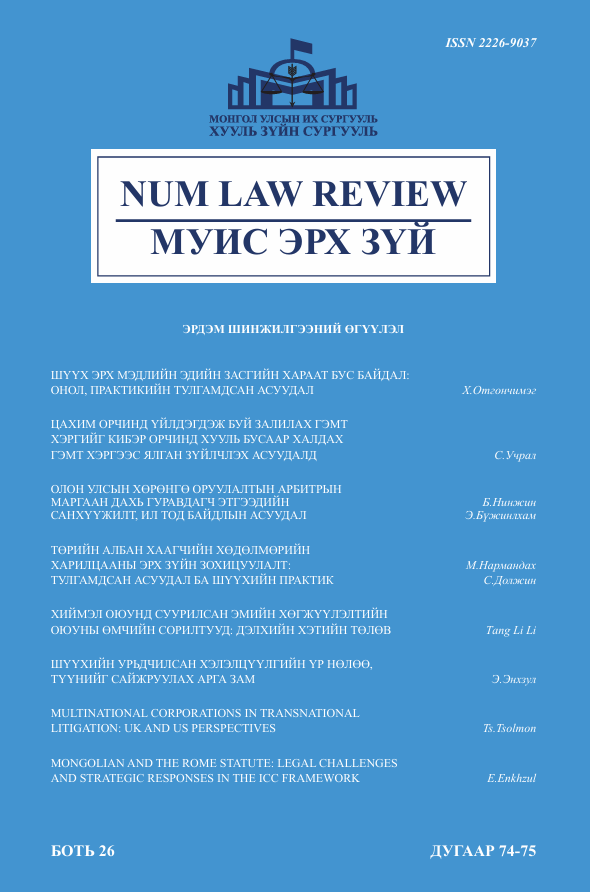
Multinational Corporations in Transnational Litigation: UK and us Perspectives
DOI:
https://doi.org/10.22353/nlr.2025.04.07Keywords:
Multinational Corporations (MNCs), Corporate Legal Accountability, Forum Non Conveniens, Separate Legal Personality, Parent-Subsidiary Liability, Comparative Legal Analysis (U.S and U.K Law), Corporate Governance and Responsibility, Jurisdictional Challenges, Transnational Litigation, Procedural and Substantive LawAbstract
This article addresses the specific question of holding MNCs, to legal account for the consequences of their unlawful actions that has been emphasized in recent years. MNCs are protected by the legal principles of “forum non conveniens” and “separate of corporate identity”. This topic is quite broad and requires extensive research, so I have decided to divide the article into two parts, with this being the first one. This part examines the complex issue of suing multinational corporations (MNCs) and the challenges of forum shopping in transnational litigation. It first outlines the conceptual framework of MNCs and explores the legal and procedural difficulties plaintiffs face when pursuing claims either in a corporation’s home or host jurisdiction. The discussion then focuses on the doctrine of forum non conveniens a key legal tool for determining the most appropriate forum for litigation. It is the aim of this paper to analyse and discuss the principal legal and policy issues raised cases involving multinational corporations in the U.S and U.K. courts and to reach complex analyses and a conclusion on the subject.
Downloads
Published
How to Cite
Issue
Section
License
Copyright (c) 2025 Tsolmon Tsedev

This work is licensed under a Creative Commons Attribution-NonCommercial 4.0 International License.
Copyright on any research article in the NUM Law Review is retained by the author(s).
The authors grant the NUM Law Review license to publish the article and identify itself as the original publisher.

Articles in the NUM Law Review are Open Access articles published under a Creative Commons Attribution-NonCommercial 4.0 International License - CC BY NC.
This license permits use, distribution and reproduction in any medium, provided the original work is properly cited.
