
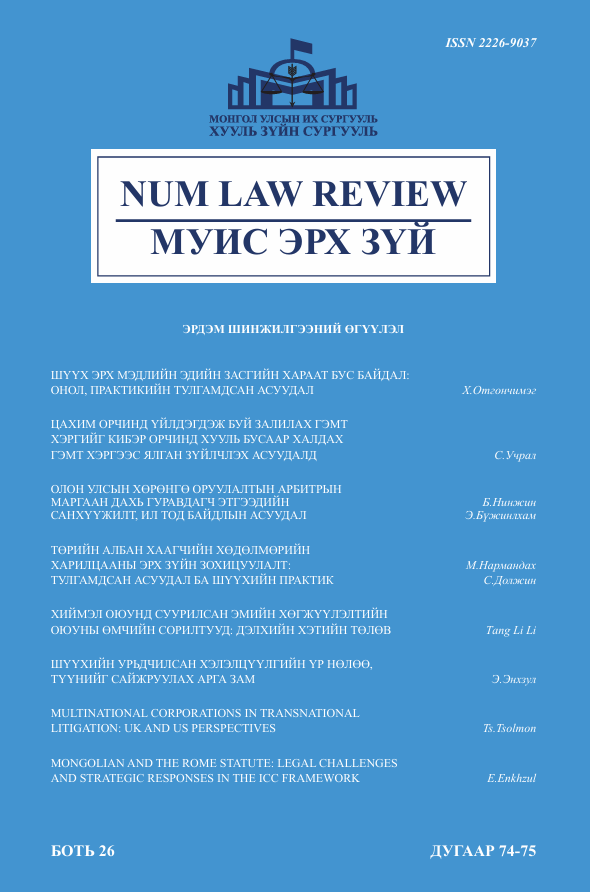
Economic Independence of The Judiciary: Challenges In Theory and Practice
DOI:
https://doi.org/10.22353/nlr.2025.04.01Keywords:
Constitution, Judiciary, Economy, Economic independence of the judiciary, State budget, Executive branch, Legislative branch, Separation of powersAbstract
This study examines the economic independence of the judiciary in relation to the principle of separation of powers within a democratic state structure and analyzes the gap between the legal regulation and practical implementation of judicial economic independence. The judiciary renders impartial decisions in accordance with the law, and its independence is conditioned not only by procedural guarantees but also by financial and material safeguards. However, the analysis conducted in the main body of the research reveals that in Mongolia, the process of judicial budget formulation, approval, and allocation is not entirely free from the influence of the executive and legislative branches. Furthermore, inconsistencies within the legal framework have contributed to continued budget reductions, which negatively affect the stability of judicial operations, human resources, and institutional capacity.
Comparative international research indicates that in jurisdictions where institutional safeguards and clear procedural guarantees exist in the budget formulation process, the financial independence of the judiciary is implemented more effectively, thereby strengthening the practical realization of the separation of powers. Although Mongolia’s legal framework recognizes budgetary guarantees for the judiciary in the Constitution and the Law on the Judiciary, the study finds that practical limitations and institutional weaknesses prevent full realization of economic independence.
Accordingly, enhancing a system that determines judicial funding based on objective institutional needs, workload, and operational requirements—free from undue executive influence—is essential for strengthening both the economic independence of the judiciary and the quality, accessibility, and public trust in judicial services. By comparing legal regulation, international experience, and Mongolian practice, the research identifies the need to improve institutional and procedural safeguards to reinforce judicial economic independence. This is crucial for ensuring the effective implementation of the separation of powers as a fundamental principle of a rule-of-law state and for institutionalizing the economic independence of the judiciary.
Шүүх эрх мэдлийн эдийн засгийн хараат бус байдал:
Онол, практикийн тулгамдсан асуудал
[Товч утга]
Энэхүү судалгаа нь шүүх эрх мэдлийн эдийн засгийн хараат бус байдлыг ардчилсан төрийн тогтолцооны үндсэн зарчим болох эрх мэдэл хуваарилалттай холбон судалж, шүүх эрх мэдлийн эдийн засгийн хараат бус байдлын эрх зүйн зохицуулалт болон практик хэрэгжилтийн зөрүүг судалсан. Шүүх байгууллага нь хуульд захирагдан төвийг сахисан шийдвэр гаргах бөгөөд түүний бие даасан байдал зөвхөн процедурын төдийгүй санхүү, материаллаг баталгаагаар нөхцөлддөг. Гэвч судалгааны үндсэн хэсэгт хийсэн шинжилгээний үр дүнгээс үзэхэд Монгол Улсад шүүхийн төсөв боловсруулах, батлах, хуваарилах процесс нь гүйцэтгэх болон хууль тогтоох эрх мэдлийн нөлөөллөөс бүрэн ангид бус, эрх зүйн зохицуулалт хоорондоо зөрчилдсөн зэрэг нөхцөл байдлаас үүдэн төсвийг танах практик үргэлжилж байгаа нь шүүхийн үйл ажиллагааны тогтвортой байдал, хүний нөөц, дэд бүтцийн чадавхад сөргөөр нөлөөлж байна.Олон улсын харьцуулсан судалгаанаас үзэхэд шүүхийн байгууллагын төсвийг боловсруулах шатанд институтийн хамгаалалт, процедурын тодорхой баталгаа бүрдсэн улс орнуудад шүүхийн санхүүгийн хараат бус байдал илүү тогтвортой хэрэгждэг бөгөөд энэ нь эрх мэдэл хуваарилалтын зарчмын бодит хэрэгжилтийг дэмждэг байна. Харин Монгол Улсын эрх зүйн орчинд шүүхийн төсвийн баталгааг Үндсэн хууль болон Шүүхийн тухай хуульд тусгасан боловч практик түвшинд төсвийн хязгаарлалт, институтийн сул механизм нь эдийн засгийн хараат бус байдлыг бүрэн хангахгүй байгааг судалгаагаар тогтоохыг зорьсон. Иймээс шүүх эрх мэдлийн эдийн засгийн хараат бус байдлыг гүйцэтгэх эрх мэдлийн нөлөөнөөс нөлөөллөөс ангид, бодит хэрэгцээ, ачаалал, институтийн шаардлагад тулгуурлан тогтоодог тогтолцоог боловсронгуй болгох нь шүүх эрх мэдлийн эдийн засгийн хараат бус байдал болоод үйл ажиллагааны чанар, хүртээмж, иргэдийн итгэлийг сэргээх суурь нөхцөл юм. Судалгааны зорилтын хүрээнд эрх зүйн зохицуулалт, олон улсын туршлага, Монгол Улсын практикийг харьцуулан шинжилснээр шүүхийн эдийн засгийн хараат бус байдлыг бэхжүүлэхэд институтийн болон процедурын хамгаалалтыг нэмэгдүүлэх, сайжруулах шаардлагатай болохыг тогтоосон билээ. Энэ нь ардчилсан эрх зүйт төрийн үндсэн зарчим болох эрх мэдэл хуваарилалтын бодит хэрэгжилтийг хангах, шүүх эрх мэдлийн эдийн засгийн хараат бус байдлыг институтийн түвшинд баталгаажуулахад чухал ач холбогдолтой гэж үзэж байна.
[Түлхүүр үг]
Үндсэн хууль, Шүүх эрх мэдэл, Эдийн засаг, шүүх эрх мэдлийн эдийн засгийн хараат байдал, улсын төсөв, Гүйцэтгэх эрх мэдэл, Хууль тогтоох эрх мэдэл, эрх мэдлийн хуваарилалт.
Downloads
Published
How to Cite
Issue
Section
License
Copyright (c) 2025 Otgonchimeg Khurelchuluun

This work is licensed under a Creative Commons Attribution-NonCommercial 4.0 International License.
Copyright on any research article in the NUM Law Review is retained by the author(s).
The authors grant the NUM Law Review license to publish the article and identify itself as the original publisher.

Articles in the NUM Law Review are Open Access articles published under a Creative Commons Attribution-NonCommercial 4.0 International License - CC BY NC.
This license permits use, distribution and reproduction in any medium, provided the original work is properly cited.
