
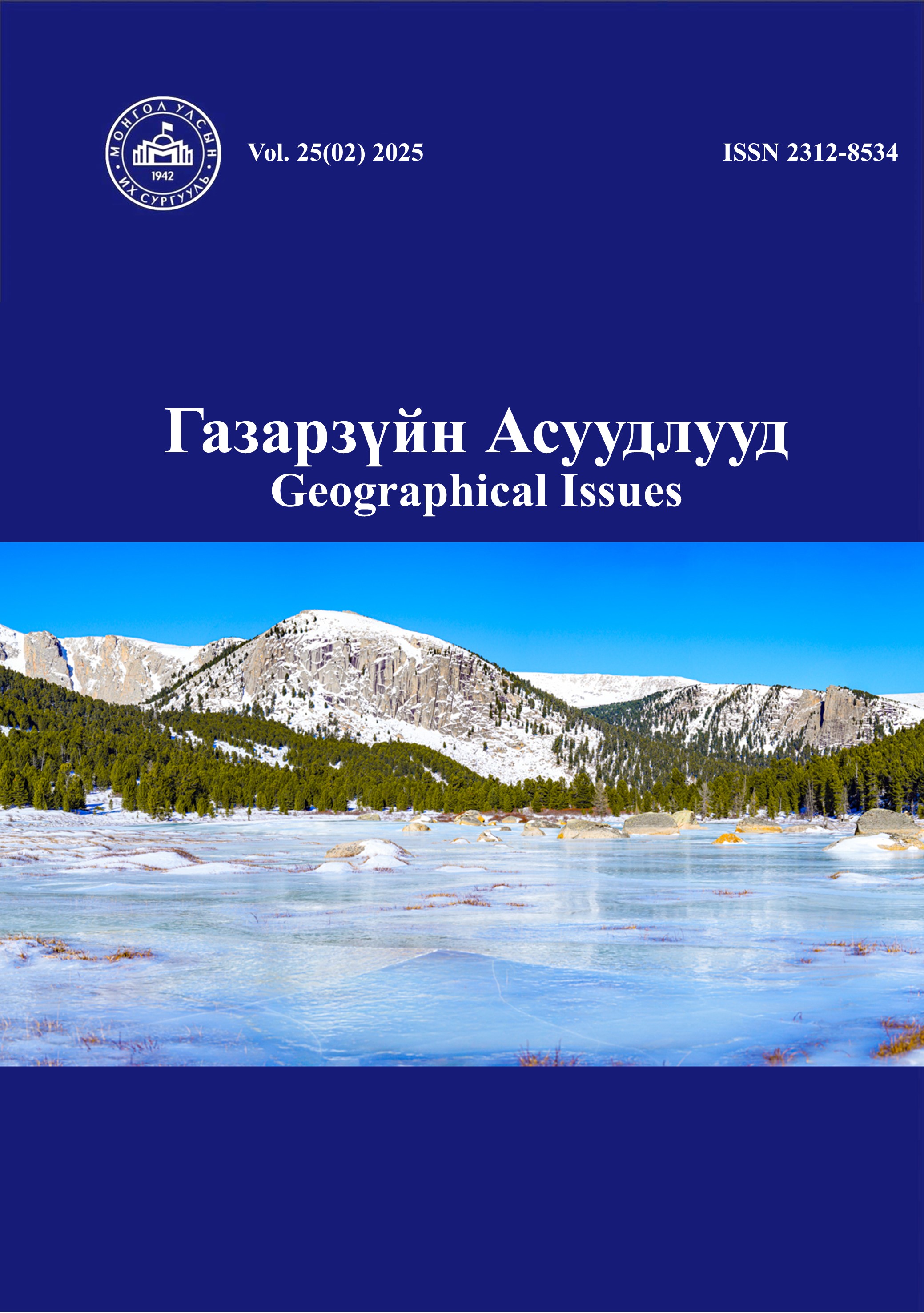
Climatic Study of Site of Chinggis Khaan International Airport in the Khushig Valley
Хөшигийн хөндийд байрлах Чингис хаан олон улсын нисэх онгоцны буудал орчмын уур амьсгалын судалгаа
DOI:
https://doi.org/10.22353/gi.2025.25.14Keywords:
Climate, Khushig valley, Air temperature, Wind speed, Cloud amountAbstract
In connection with the construction of a new international airport, the Civil Aviation Administration of Mongolia made a decision to urgently develop a climate profile for the Khushig Valley in 2001. Within the framework of this decision, researcher B. Jigmeddorj developed a climate profile for the area in 2007. The climate profile was developed using data from the automatic weather station located in the Khushi Valley for the years 2002-2006. Although the climate profile developed by B. Jigmeddorj met the requirements of the time, it had shortcomings such as the lack of night-time meteorological observations and visual observations of weather phenomena. On the other hand, it is relatively outdated in terms of time and does not fully meet current requirements. Therefore, this study aimed to develop a climate profile for the Khushi Valley area using actual observation (METAR) data. During the study period, the average air temperature in the Khushi Valley area was -0.4°C, the absolute maximum temperature reached 34.0°C in July, and the absolute minimum temperature reached -39.0°C in January. The absolute minimum temperature reached -2.0°C in January, it reached 6.0°C in July, and it was below 0.0°C in the months other than the summer months, for example, -7.0°C in May and -10.0°C in September. The annual total precipitation in the Khushig Valley area was 249.7 mm. The frequency of no wind or “calm” is 23-41%, while the prevailing wind directions are from the Northwest (NW), West (W), East, northeast (ENE), and East (E). The highest frequency of strong winds mainly blows from the Northwest (NW) and North, northwest (NNW). The average wind speed of more than 4 m/s in any month or at any time of the day is considered to be a very windy area around the aerodrome in the Khushi Valley. Despite the high wind speed, the wind from the East, Southeast (ESE) and the West, Northwest (WNW), i.e. the tailwind frequency on the runway is low, namely, the wind speed above 16 m/s was observed only 4 times during the entire measurement period. Winds of 5 m/s and above along the runway are local or from the East (E), while winds of 12 m/s and above along the runway are crosswinds or from the West, Northwest (WNW). The number of cases where the base of the lower atmosphere was 300 m or lower was 0.07-0.11% of the total measurements between 22:00 and 02:00, 0.14-0.16% of the cases observed between 301 and 600 m, and 0.01% of the cases observed in the layer of 601 and 800 m. The study considered the number of cases of lower atmosphere clouds BKN - cloudy (5-7 octas), OVC - overcast (8 octas). It was found that the frequency of cases reaching the OVC level in the spring season near the aerodrome located in the Khushig Valley reaches almost 23.2%.
Downloads
Downloads
Published
How to Cite
Issue
Section
License

This work is licensed under a Creative Commons Attribution-NonCommercial-ShareAlike 4.0 International License.


